





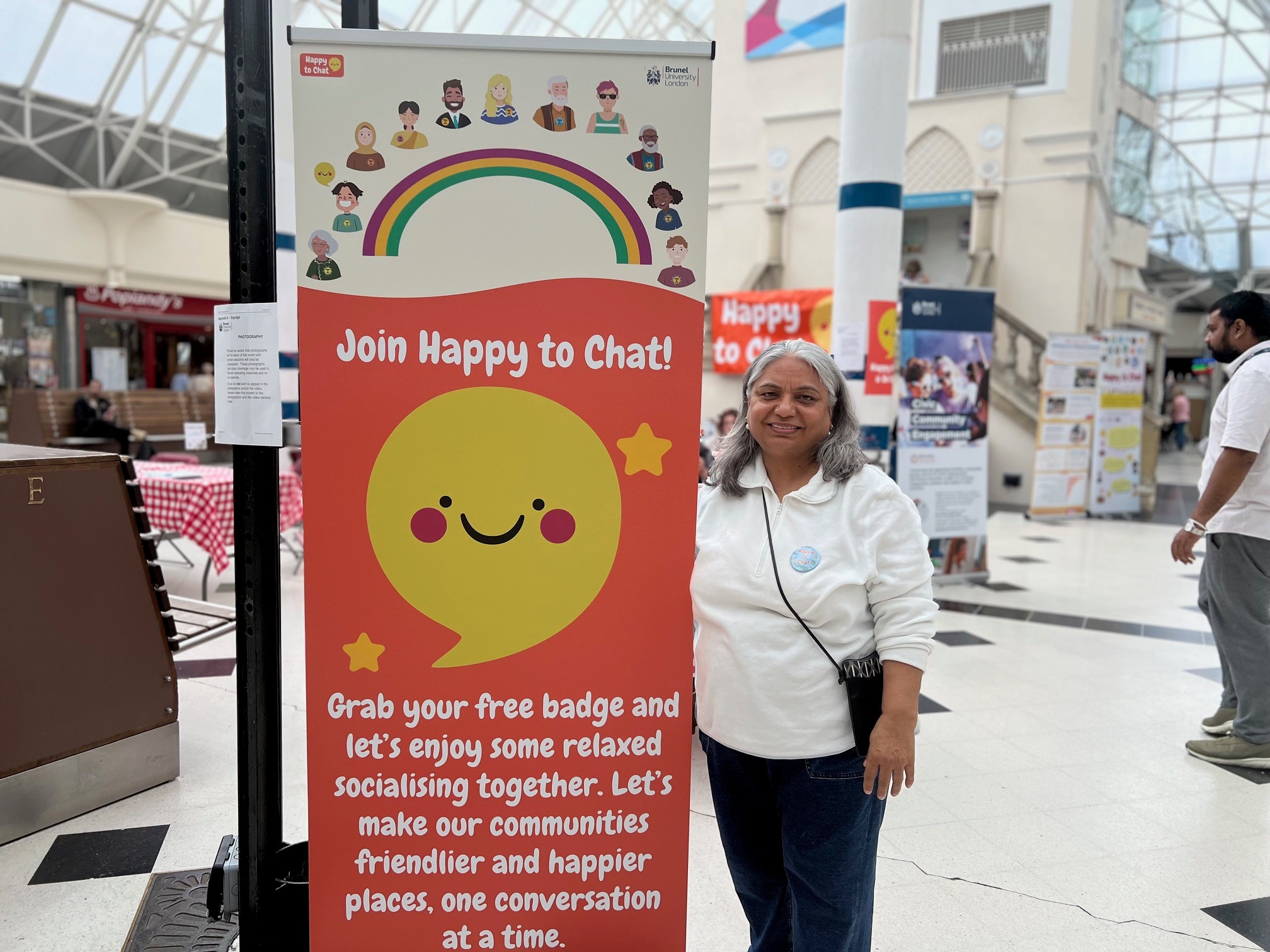
I am delighted to share that our latest Happy to Chat paper has now been published open access in the Journal of Happiness Studies.
The paper, The Nudge Effect of “Happy to Chat” Badges: Evidence from England, explores a simple but meaningful question: can a visible sign of openness to conversation change how a person is perceived by others, and make everyday social connection more likely?
At Happy to Chat, this question is closely tied to our purpose. The initiative was founded on a very simple idea: that small moments of acknowledgement between people matter. A smile, a greeting, a brief exchange in a shop or on a street may seem minor, but these moments can bring warmth, reassurance and a sense of belonging. For many people — particularly older adults who may be living with loneliness or reduced social contact — such interactions can make a real difference to how connected they feel to the world around them.
Why this research is important
Much of human interaction begins before a word is spoken. We make quick judgments about whether someone seems approachable, friendly or open to contact. Those first impressions often shape whether we smile, make eye contact, say hello, or simply move on.
The Happy to Chat badge was designed to make those moments a little easier. It offers a gentle signal that conversation is welcome, helping to reduce the uncertainty that can sometimes prevent people from reaching out to one another. Our study asked whether the badge does more than communicate openness — whether it also changes the way a person is seen by others.
This matters because many barriers to connection are not dramatic or obvious. Often, they are quiet and everyday: uncertainty, hesitation, the fear of interrupting, or the assumption that the other person would rather be left alone. When those barriers can be softened, even slightly, opportunities for connection can begin to open up.
What the study looked at
In the study, participants were shown images of four individuals — an older man, an older woman, a middle-aged man and a middle-aged woman. Some participants saw these individuals wearing a Happy to Chat badge, while others saw the same individuals without a badge.
Participants were then asked to rate how friendly and trustworthy each person appeared, and how likely they would be to acknowledge them in a public setting through eye contact, a smile or a nod.
This allowed us to explore whether the presence of the badge influenced not only perception, but also people’s willingness to respond socially.
What we found
The findings were encouraging.
Individuals shown wearing a Happy to Chat badge were perceived as friendlier and more trustworthy than those not wearing a badge. Participants were also more likely to say they would acknowledge them in an everyday public setting.
These results suggest that the badge acts as more than a simple identifier. It appears to serve as a positive social cue — one that shapes first impressions and helps make social contact feel more natural, comfortable and welcome.
That is important because many everyday interactions begin in precisely this way. Before conversation comes recognition: a glance, a smile, a nod that says, “I see you.” The badge may help create the conditions for those moments to happen.
Why this matters for older adults and the wider community
These findings are especially relevant for organisations and communities working to support older people.
Loneliness and social isolation can have a profound effect on wellbeing, confidence and quality of life. While no single intervention can address these challenges on its own, small and practical tools can still play a valuable role. A visible invitation to connect may seem modest, but this research suggests it can influence how people are perceived and how likely others are to respond.
For older adults in particular, everyday social acknowledgement can carry real significance. Feeling noticed, welcomed or included in ordinary public settings can help strengthen a sense of dignity, belonging and connection. For organisations committed to healthy ageing, community wellbeing and social inclusion, this points to the value of approaches that are simple, compassionate and easy to use in daily life.
More broadly, the study reminds us that creating kinder communities is not only about major programmes or formal services. It is also about the social tone of everyday life — whether people feel able to acknowledge one another, and whether public spaces feel open to human connection.
What this means for Happy to Chat
For Happy to Chat, this publication is an important step in building the evidence base for what many supporters, volunteers and partner organisations have long understood in practice: that small signals can make connection easier.
The badge has always been intended as a simple way of inviting interaction. What this study suggests is that it may also positively influence how a person is seen by others, increasing the likelihood of recognition and response.
That is both encouraging and meaningful. It reinforces the idea that small acts of openness can have a wider social effect. Not every intervention needs to be complex to matter. Sometimes, something as simple as a badge can help create a more welcoming encounter between strangers.
Looking ahead
We hope this paper contributes to wider conversations about loneliness, ageing, public interaction and the practical steps communities can take to support wellbeing.
For charities, local authorities, community groups, researchers and others working in this space, the findings offer a hopeful message: small, low-cost interventions may help reduce social barriers and make everyday connection more possible.
At Happy to Chat, we remain committed to encouraging those moments of openness that help people feel seen, valued and less alone. We are very pleased that this new research adds further support to that mission, and we look forward to continuing the conversation with the many organisations and individuals who share these goals.
Read the paper
Our paper, The Nudge Effect of “Happy to Chat” Badges: Evidence from England, is now available open access in the Journal of Happiness Studies.
Comments are closed